


What Is a Managed Ethernet Switch?
Digisol2026-11-16T14:53:24+05:30What is a Managed Ethernet Switch?
If you’ve ever looked into upgrading your office or data center network, you’ve probably come across the term “managed switch.” It sounds technical, and in some ways, it is, but the idea behind it is fairly simple once you break it down.
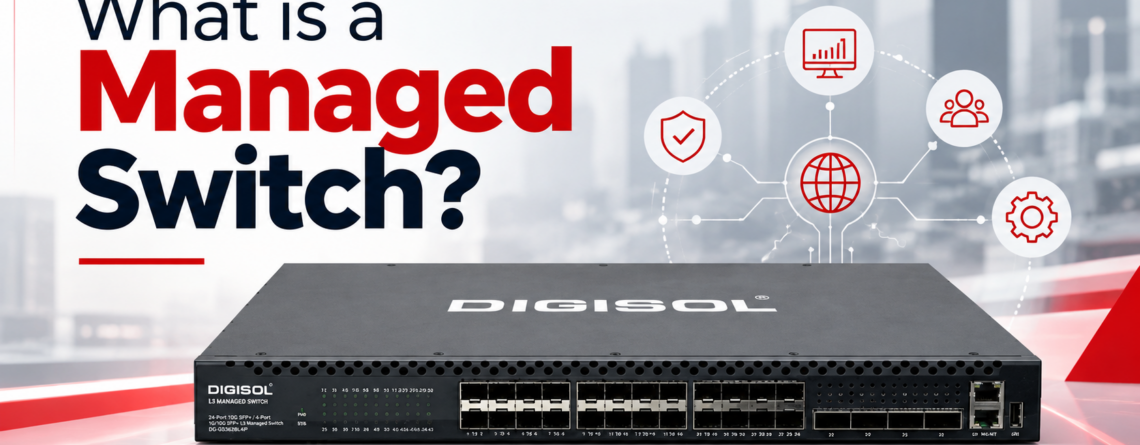
A managed Ethernet switch is a networking device that lets you control, monitor, and configure how data moves across your network. Unlike a basic unmanaged switch, which just passes data between connected devices with no oversight, a managed switch gives network administrators visibility into traffic, the ability to set rules, and tools to troubleshoot problems before they turn into downtime.
Think of an unmanaged switch as a simple traffic junction. Cars go through, and that’s it. A managed switch is more like a junction with traffic signals, cameras, and a control room. You can see what’s happening, adjust the flow, and step in when something goes wrong.
Why do businesses choose managed switches?
Small home networks usually don’t need this level of control. But as soon as a network starts supporting multiple departments, sensitive data, VoIP calls, security cameras, or a data center environment, an unmanaged switch quickly runs out of capability.
Here’s what a managed switch typically brings to the table:
Network segmentation (VLANs)
You can split one physical network into multiple virtual ones. This keeps departments or device types separate, which improves both performance and security. For example, your finance team’s traffic doesn’t need to mix with your guest Wi-Fi traffic.
Traffic prioritization (QoS)
Not all data is equally time sensitive. A managed switch lets you prioritize things like video calls or VoIP traffic over less urgent tasks like file downloads, so critical applications stay smooth even during peak usage.
Remote monitoring and management
Instead of physically checking each device, administrators can log in to a central dashboard, view network health, spot unusual activity, and make changes without leaving their desk.
Redundancy and reliability
Features like Spanning Tree Protocol help prevent network loops and keep the network stable even if a cable or connection fails.
Stronger security controls
Managed switches allow port-level security, access restrictions, and authentication protocols, giving IT teams a way to limit who and what can connect to the network.
Managed vs unmanaged: the core difference
The easiest way to think about it is control versus simplicity.
An unmanaged switch works right out of the box. Plug it in, connect your devices, and it works. There’s nothing to configure and nothing to break.
A managed switch takes a little more setup, but in return, it gives you visibility and control over exactly how your network behaves. For a small home setup, that control might be unnecessary. For a growing business, a data center, or any environment where uptime and security matter, it’s often essential.
Where managed switches make the biggest difference
Data centers, where consistent uptime and fast troubleshooting are non-negotiable
Offices with multiple departments, where traffic needs to be segmented for security and performance
Environments running VoIP or video conferencing, where call quality depends on traffic prioritization
Networks with surveillance systems, where bandwidth needs to be managed carefully alongside regular business traffic
Any setup where IT teams need to monitor and respond to issues remotely, rather than physically inspecting hardware
Is a managed switch right for you?
If your network is small, stable, and doesn’t handle sensitive data, an unmanaged switch might be all you need. But if you’re dealing with growing traffic, multiple locations, security requirements, or applications that can’t afford interruptions, a managed switch gives you the tools to stay ahead of problems instead of reacting to them after the fact.
Digisol’s range of managed switches is built for exactly this kind of environment, offering the configuration options, monitoring tools, and reliability that growing networks need.
[View Managed Switches →]